

Recorded talk by Aleksija Neimanis and Astrida Neimanis
Every year, hundreds of whales and other marine mammals strand on terrestrial shores. These ocean-dwelling animals are mostly hidden from humans during their lifetimes, but in a stranding death, they reveal themselves to us, and call on us to care. What might this care look like? What can these deaths teach us about the entangled futures of humans and oceans?
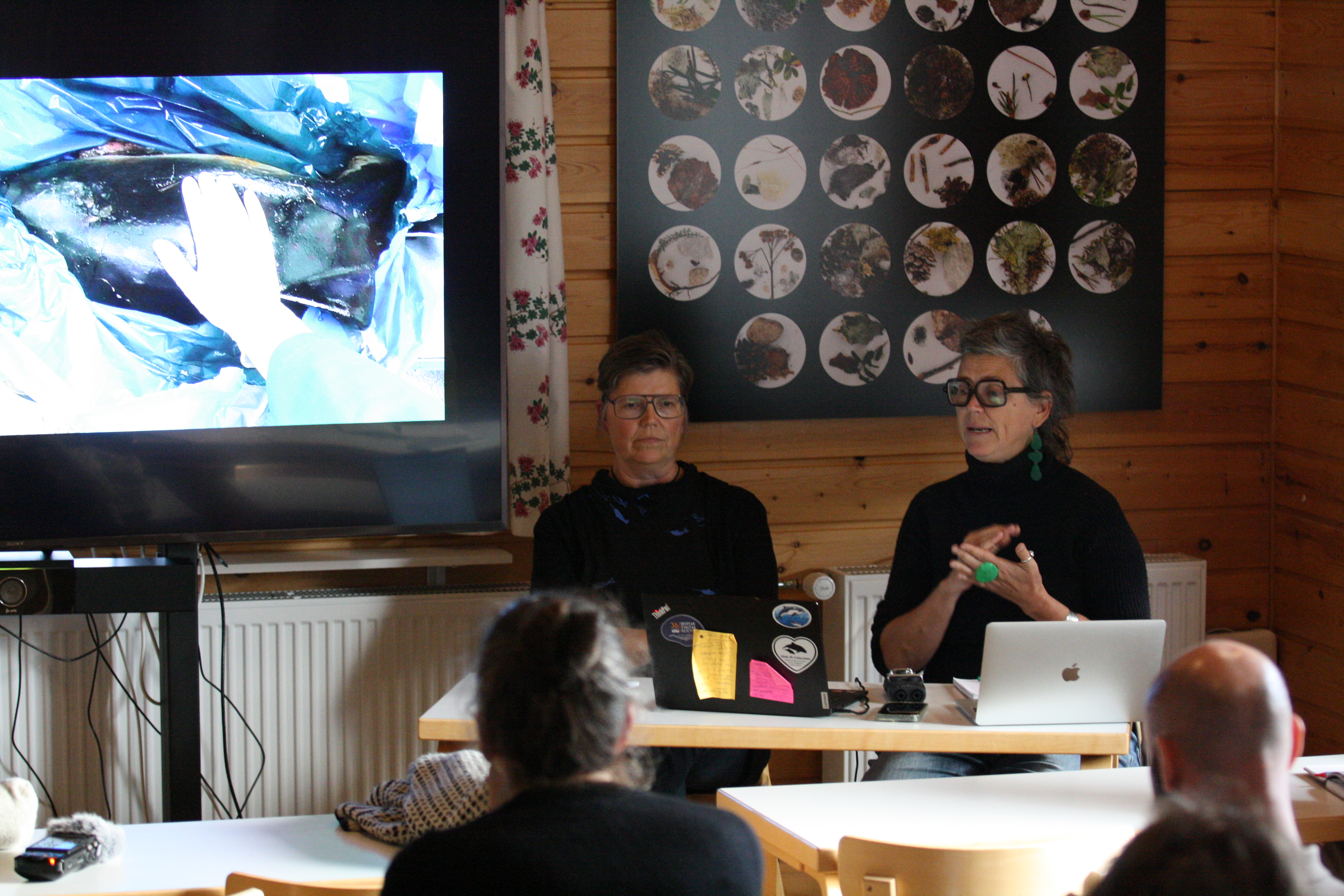
During Bioart Society’s eighth field laboratory, Field_Notes: Living Methodologies, at Kilpisjärvi Biological Station in September 2025, two of our invited contributors Aleksija Neimanis and Astrida Neimanis hosted a public talk, welcoming visiting researchers and local audiences to learn more about art-science collaborations in practice
Through their collaborative research project Learning Endings—informed by Alesija’s work as veterinary pathologist, Astrida as a cultural theorist and Patty Chang as an artist—they offer intimate and self-reflective insights on the ways arts-sciences collaborations can change how scientists perceive and practice their work. They wonder: can art also care for science?
Recording:
Aleksija Neimanis is a veterinary pathologist and researcher who works with wildlife health and disease surveillance. She studies wildlife health issues, including emerging and re-emerging diseases. Aleksija frames wildlife health findings within a One Health context, in which human, animal and ecosystem health are all connected. Since 2020, Aleksija has been part of an arts-science collaboration Learning Endings together with Astrida Neimanis and artist Patty Chang. Currently, Aleksija leads the Research and Development Section in the Department of Pathology and Wildlife Diseases at the Swedish Veterinary Agency and is Associate Professor in Wildlife Health at the Swedish University of Agricultural Sciences.
Astrida Neimanis is a practice-led cultural theorist working at the intersection of feminism and environmental change. Astrida’s international research practice includes collaborations with artists, writers, scientists, makers, educational institutions, and communities, often in the form of experimental public pedagogies. Her 2017 book, Bodies of Water: Posthuman Feminist Phenomenology, is a call for humans to examine our relationships to oceans, watersheds, and other aquatic life forms from the perspective of our own primarily watery bodies. Her forthcoming book, co-authored with longtime collaborator Jennifer Mae Hamilton, is called How to Weather Together: Feminist Practice for Climate Change (2026)—an accessible theoretical and practical guide to the redistribution of shelter and vulnerability, guided by anticolonial, antipolarizing and antifascist feminist commitments. Currently, Astrida is Associate Professor and Canada Research Chair in Feminist Environmental Humanities at UBC Okanagan, on stolen territories of the syilx Okanagan people in Kelowna, BC, where she is also Director of the FEELed Lab, established in 2021.
Astrida Neimanis has also written a reflective post, Field_Notes 2025 (FEELed Lab in the Field!), on their FEELed Lab website