

Following this year's reframing and restructuring of our long-term residency programme Ars Bioarctica in collaboration with Kilpisjärvi Biological Station, to better align it with their seasonal work and long term monitoring projects, we were delighted to have such a positive response to the open call. We received many inspiring and intentional proposals seeking to initiate or continue site responsive research in Gilbbesjávri.
The selection panel consisted of Bioart Society staff Yvonne Billimore, Eliisa Suvanto, Lukáš Karaba, board member Aleksija Neimanis and Ars Bioarctica local host Leena Valkeapää. We read the applications with real interest and want to thank everyone who applied.
A total 18 projects / 22 practitioners were selected for residencies between November 2026 and November 2027.
Writer and artist Camille Auer returns to Gilbbesjávri to continue researching arctic wading birds for a novel-length essay about her years-long obsession with finding information about birds' lifeways and characteristics that deviate from cis- and heteronormative conceptions of how nature works.
Alan Bogana’s artistic research investigates light as both material phenomenon and ecological agent. At the station he will examine how airborne micro-contaminants interact with winter atmospheric dynamics. Observing snow structures and particulate deposits his research aims to connect microscopic pollutants with larger cycles of radiation, energy exchange, and circulation.
B. Bruder aka beta version, an artist, designer, and lecturer for art, design and media, proposes the project "Planetary Narratives in Tundra Liminality" investigating liminality as a planetary condition in the subarctic environment in Gilbbesjávri in a state of transition where environmental, temporal and atmospheric systems overlap and reconfigure.
Penelope Cain's practice centres on air, earth & water storytellings from the End-Holocene. Cain will consider notions around ‘core sampling’ exploring them as columns of matter that speak—historical voices held within planetary media.
Elena Cirkovic, an artist and researcher at the Department of Law, Aarhus University will undertake fieldwork for her book with Audrey Rangel Aguirre Spheres of Light: Earth-Space, specifically the cryospheric and atmospheric chapters which examine how climate-driven atmospheric contraction alters both surface albedo and the orbital lifetime of space debris.
Corinna Dean’s residency project “Wet ontologies, rediscovering ground through seed dormancy and transgressions” researches birch seed ecologies, looking at seed dispersal, framings of terms such as cultivation, and colonisation in the plant world, as well as looking at how these seed transfers are in dialogue with the ground.
As a duo, artists Cyane Findji & Myriam Gras foster long-term interdisciplinary dialogues with researchers. Collaborating with marine biologist Erik Wurz from Tvärminne Biological Station (University of Helsinki), who coordinates the Polar Scientific Diving Course at the Station and trains scientists to work in extreme polar environments, they will follow the diving field course, documenting the training process and scientific practices.
Angela Fragkou’s site-specific phenological pigment project, works with bilberry flowers and birch seeds, as a practice-based investigation of micro-seasonal events in the subarctic summer, combining field observation, chemical extraction and material experimentation.
Scott Howarth is a researcher and student in Architecture, with an interest in challenging anthropocentric design frameworks and reframing architecture within multi species futures. Gilbbesjávri offers a context to investigate ecological processes that are both fragile and visible, supporting research that can contribute to climate responsive architectural discourse.
Kana Kobayashi, a composer, sound artist, and video artist will conduct field-based audiovisual research within a subarctic environment with a central interest in snow and ice algae, including Sanguina nivaloide, Ancylonema nordenskioldii, and cryoconite communities—organisms associated with albedo reduction in polar environments (bio-albedo effect).
Hans Kuzmich, an artist employing site-specific listening and sonic fiction methodologies, will listen into the acoustic and transmission ecology of Gilbbesjávri—a landscape where natural electromagnetic phenomena and military infrastructure occupy the same frequency band.
Nina Liebenberg will curate a local research stage at the Kilpisjärvi Biological Station to bring together scientific data, artistic investigations, archival materials, and field observations from visiting and resident researchers to explore how alternative curatorial strategies can mediate and reframe research materials across disciplines.
Artist Egle Oddo will develop her work with Mount Etna’s birch populations (Betula aetnensis) in a site-specific study in Gilbbesjávri. After naturally migrating southward during the last glacial maximum, the trees are now moving north in response to rapid climate change. The project stages their conceptual “return” to the boreal latitudes from which their ancestors departed 20.000 years ago.
Landscape architect and architect Sonia Ralston’s project 'Plant Migrations' explores the relationship between the mountain birch ecologies, the growth of information infrastructure and the politics of data center development on forest land in Finland, in the context of environmental change.
Artists Christina Stadlbauer & François Zajéga extend the notion of endangered habitats to include the idea of a “non-digital habitat”. The residency becomes a speculative exploration of what it means to inhabit such a space and frames going offline not as escape, but as a form of cleansing to regain perceptual clarity, rebalance human–machine relations, and imagine adjacent futures beyond digital inevitability.
Sororitas ex Mycelio (Tosca Terán & L. Puska) approach the residency as an opportunity to listen at a threshold: the ecological and climatic edge where Boreal forest transitions toward Arctic systems. They ask: How does a boundary feel from within? What can symbiosis teach us about survival in a time of thaw?
Artists Thomas Westphal & Uli Westphal plan to work with local water bodies such as Gilbbesjávri Lake and molten snow as source materials to build ephemeral mechanisms, documented within their short moment of existence.
With an interest in liminal beings that embody processes of loss, resilience and transformation, artist Maria Ångerman will investigate nocturnal ecology in the subarctic summer—a paradoxical condition in which darkness dissolves into continuous light.
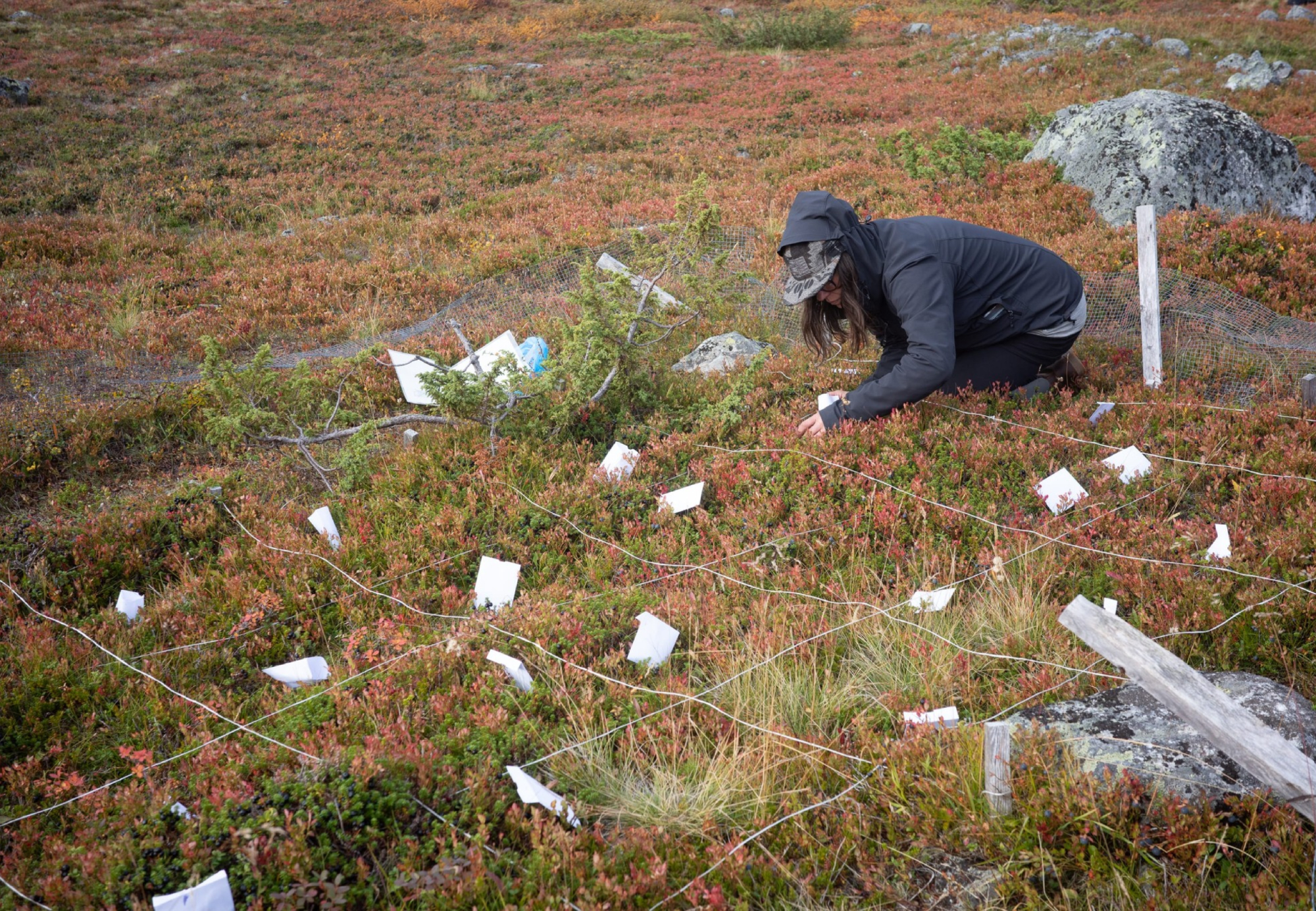
Photo by Till Boverman